You’ll get a rugged, fanless P10 LED ticker that’s built for sports venues and mobile setups, offering a 10 mm pixel pitch, 96×16 canvas, and 5,000 cd/m² brightness so scores and alphanumerics stay legible in daylight. It runs 16M colors, 80k–100k hour life, and low driver latency for synced events. Control is via WiFi or USB with stored program slots and remote diagnostics. Keep going and you’ll find setup, power, and buy-or-pass details.
Some Key Takeaways
- P10 (10 mm) LED ribbon offers a 96×16 canvas ideal for crisp alphanumeric sports tickers visible from typical spectator distances.
- High 5,000 cd/m² brightness and high‑brightness RGB maintain color saturation and legibility in daylight.
- Lightweight aluminum, nano waterproofing, and fanless design enable rugged, silent operation for indoor/outdoor concourses.
- WiFi/USB control, Windows software, and mobile app provide real‑time content updates, playlists, and remote diagnostics.
- Long 80k–100k hour lifespan and low per‑LED power draw lower lifecycle costs versus comparable LCD alternatives.
What the P10 Sports Ticker Is and Who It’s Best For
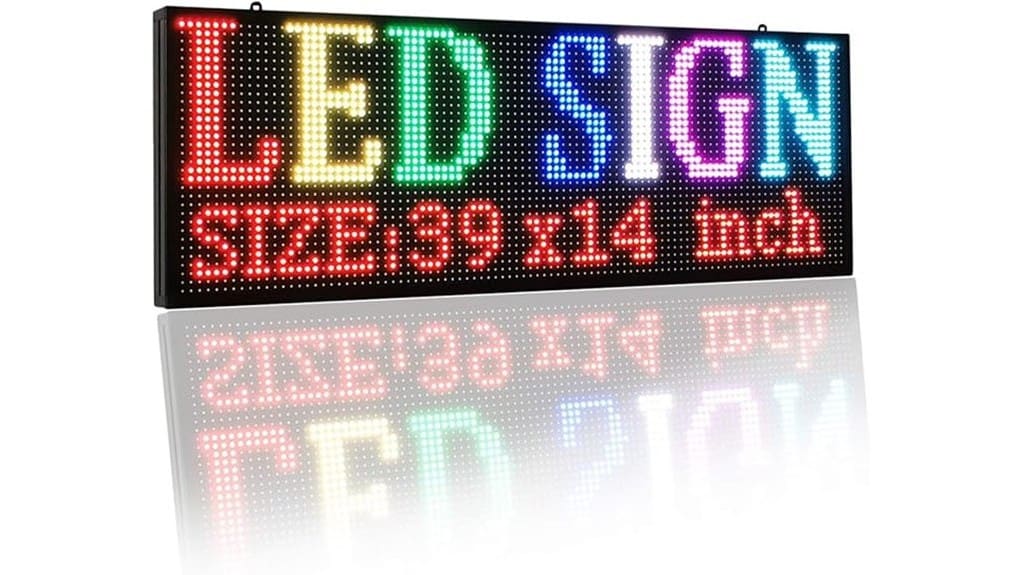
Think of the P10 sports ticker as a compact, high-brightness LED ribbon you can program to display live scores, schedules, and animated alerts—designed for venues that need clear, continuous messaging both indoors and out. You’ll find a portable edition that fits concourses, training rooms, and mobile setups; it’s lightweight yet rugged with aluminum housing and nano waterproofing. You’ll appreciate the fanless design for silent, maintenance-light operation. You’ll program via WiFi or USB, store multiple programs, and push dynamic content in real time. It’s aimed at event operators, clubs, and venues wanting reliable, modern scoreboard signage. Many buyers choose these tickers for their rotating message versatility and ease of use.
Key P10 Specs That Matter for Sports Scoreboards (Pitch, Brightness, Colors, Lifespan)
Because display specs directly shape visibility and reliability, you’ll want to focus first on pixel pitch, brightness, color depth, and rated lifespan when evaluating the P10 for scoreboards. With a 10 mm pixel pitch and 96×16 resolution, you’ll get crisp alphanumeric scores at typical viewing distances; denser pixels aren’t necessary for long-range readability. The 5,000 cd/m² brightness and high-brightness RGB LEDs guarantee sunlight-readable contrast and saturated color rendering across 16 million colors. Rated 80,000–100,000 hours gives you roughly a decade of continuous operation, lowering lifecycle cost. These metrics prioritize durability, outdoor suitability, and future-proof visual fidelity. The P10 pairs well with durable waterproof sign letters designed for clear outdoor messages, improving long-term legibility and weather resistance when mounted together with waterproof sign letters.
Real-World Performance: Visibility, Animations, and Scrolling Modes in Stadiums and Venues
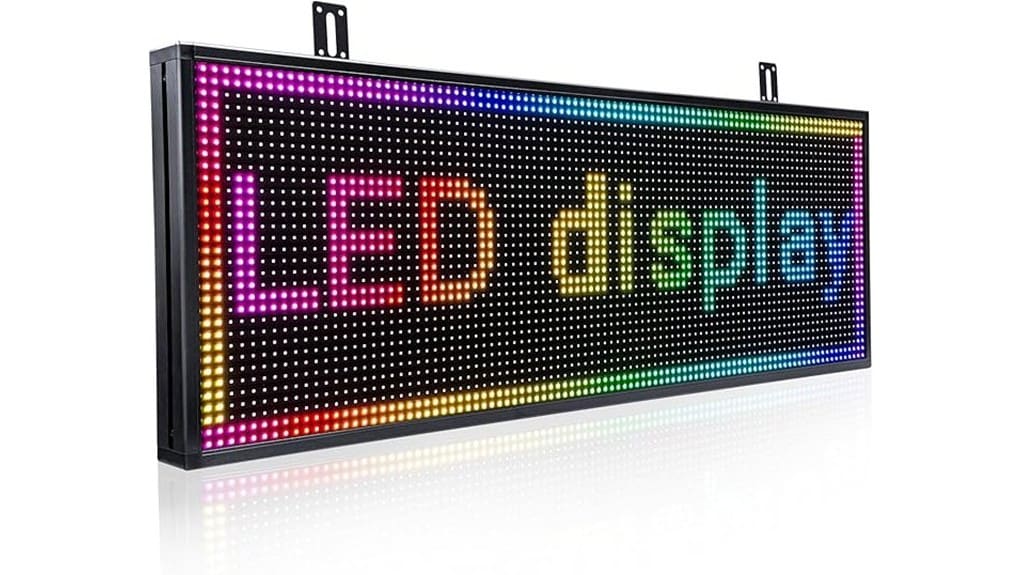
When you place a P10 panel in a stadium or venue, its 10 mm pitch and 5,000 cd/m² brightness deliver clear, legible alphanumerics from typical spectator distances while high-brightness RGB LEDs preserve color saturation even in daylight. You’ll find crowd readability excellent across varied stadium sightlines; characters remain distinct without excessive LED blooming when viewed from seats and concourses. Animations and GIFs run smoothly within the 96×16 canvas, and multiple scroll modes help prioritize content visibility. Monitor driver latency for synchronization with game events—low latency keeps scores and timers credible. Overall, practical performance favors reliable, high-impact messaging. Consider using outdoor sign letters to amplify branded messages and wayfinding in venue concourses.
Installation, Connectivity, and Control: WiFi, USB, Software, and Program Storage
Hooking up and managing the P10 is straightforward: you’ll load content via WiFi (roughly 30 ft range) or USB, configure playback with Windows-compatible software, and store up to 100 protected program slots that survive power outages. You’ll appreciate robust wireless security options and clear firmware updates delivered through the management tool. Use the mobile app for quick playlist swaps and on-site tweaks, while remote diagnostics reduce downtime by reporting LED faults and power states. Configuration lets you set brightness, scroll modes, and animations precisely. The workflow is efficient, reliable, and built for iterative, innovative deployments. The system is designed for users who create messages for programmable signs and emphasizes visual design best practices to make displays more effective.
Buy-or-Pass Checklist: Cost, Power, Durability, and Recommended Use Cases
Now that you’ve seen how the P10 handles installation and content management, it’s time to evaluate whether it makes sense for your budget, power profile, and deployment environment. Do a straightforward cost analysis: compare upfront price, 10-year operational hours, and lower lifecycle costs versus LCD alternatives. Account for power draw (0.04–0.08 W per LED) to size supplies and predict energy spend. Check durability testing results: aluminum alloy housing, nano waterproofing, and 80k–100k hour lifespan mean rugged outdoor/indoor use. Recommended use cases: sports tickers, storefront messaging, transit signs where high brightness and long-term reliability matter. Consider also whether you need weatherproof letter kits to pair the display with durable outdoor signage.
Some Questions Answered
Does the Display Support Syncing Multiple Units for a Continuous Ticker?
Yes — you can sync multiple units for a continuous ticker. You’ll use synchronized playback over a networked daisychain or WiFi link to align frames and scrolls across modules. You’ll control timing, brightness and scroll modes from Windows software, store sequences in program slots, and rely on power-outage protection for stable runs. This setup gives you scalable, low-latency ticker walls with predictable behavior and easy remote updates.
Can It Integrate With Live-Play-By-Play Scoring Systems?
Yes — you can integrate it with live play-by-play scoring systems. You’ll push updates via WiFi or USB; expect low real time latency within the WiFi range, suitable for fast scoring feeds. Implement secure authentication on your feed server and device control to prevent spoofing. Configure program slots and scroll modes for instant display. You’ll want a middleware adapter to map scoring APIs to the ticker’s text/GIF capabilities for reliable, real-time operation.
What Mounting Hardware or Pole Attachments Are Compatible?
You can use VESA adapters and Ceiling mounts plus pole clamps and universal brackets; you’ll want VESA adapters for flat panels and Ceiling mounts for overhead installs. Choose aluminum pole clamps rated for outdoor use and nano-waterproof seals. Confirm weight and hole pattern against the 96×16 LED module, and use vibration-damping hardware for long-term reliability. You’ll also want access to WiFi/USB ports when positioning for programming.
Is There an API or Third-Party Software Support?
Yes — you can integrate it via Windows-compatible software and WiFi/USB programming; there’s no native public REST API but you can use third-party signage platforms that support custom feeds and scripting to push content. You’ll be able to add sponsorship overlays and ingest audience analytics from external services, then schedule or trigger displays. Use the 100 program slots and power-outage protection for resilient workflows, and consult the SDK-like docs and tutorials for integration patterns.
Are Replacement LED Modules or Spare Parts Available?
Yes — replacement modules and spare parts are available. You can swap individual LED modules to repair or upgrade the panel, reducing downtime and cost versus full-unit replacement. You’ll also find power and control board spares, connectors, and mounting components. You’ll want to source OEM parts for compatibility; authorized dealers or the manufacturer provide kits and documentation. Keep firmware and wiring specs handy to assure seamless module integration and reliable performance.