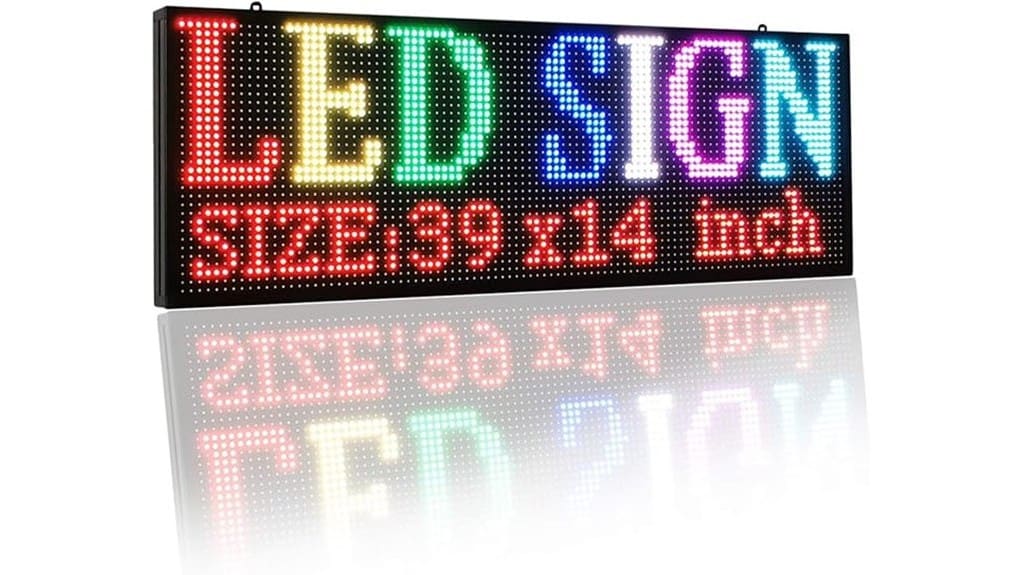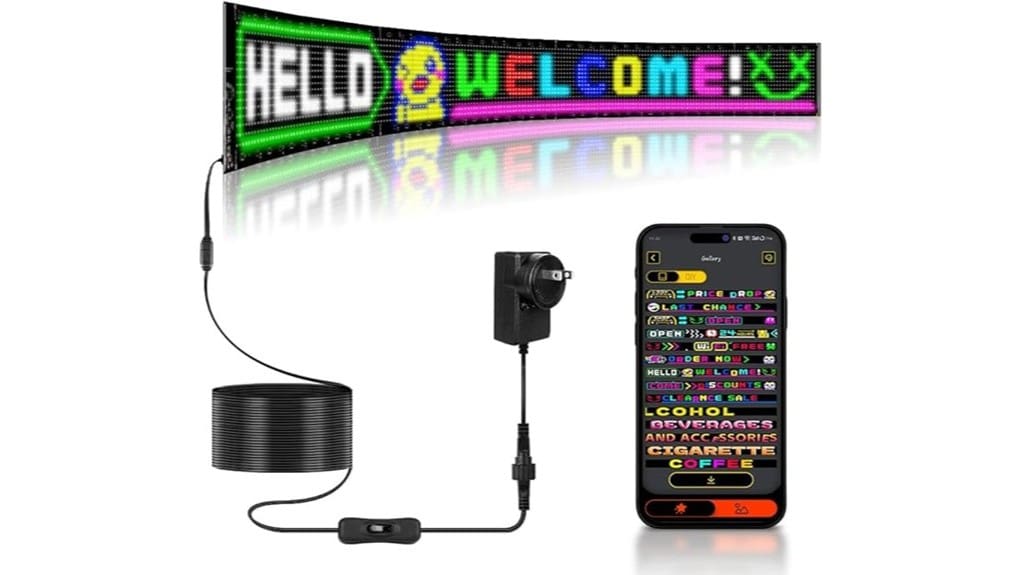
You’ll get a compact 52″×7.5″ programmable LED sign with a 16×144 pixel matrix that’s suited for clear text, simple graphics, and scrolling effects. It supports Bluetooth and Wi‑Fi control via a mobile app, offers adjustable brightness, scheduling, and music sync, and is rated IP65 for sheltered outdoor use. Power requires a 110V feed and you should plan mount and service access. Keep going and you’ll find detailed performance, setup, and deployment notes.
Some Key Takeaways
- Check pixel matrix and size (e.g., 16×144 on a 52″×7.5″) to confirm text legibility and viewing-distance suitability.
- Verify brightness, color accuracy, and effects catalog (scrolling, loops, rhythm sync) under expected ambient lighting.
- Confirm mounting options, power routing (110V upgrade), service access, and IP65 environmental protection for installation location.
- Test app setup, pairing, responsiveness, firmware updates, and exposed controls for brightness, speed, scheduling, and multilingual menus.
- Assess thermal behavior, energy consumption, duty-cycle limits, and maintenance plan to avoid thermal throttling or safety issues.
Which Size and Specs Matter for Your Space (52″ × 7.5″, 16×144 Pixels, Power)
Because the sign’s 52″ × 7.5″ footprint and 16 × 144 pixel matrix determine visibility and content density, you should match those dimensions to your viewing distance and message complexity. You assess visual footprint against intended sightlines, calculating minimum and recommended viewing distance based on pixel density. Choose mounting options that preserve angle, height, and service access—wall, ceiling, or stand—while noting power routing for 110V upgraded technology. Consider content: low-resolution graphics need larger viewing distance; text and simple animations map cleanly to the matrix. Prioritize placement that balances exposure, readability, and installation constraints for innovative deployments. For increased impact in outdoor settings, prioritize outdoor visibility when selecting sign placement and mounting.
Real-World Performance: Brightness, Color, Effects, and Modes
When you evaluate real-world performance, focus on measurable brightness, color accuracy, and the responsiveness of effects and modes under typical ambient conditions. You’ll perform brightness testing across distances and angles to verify claimed output and adjustable ranges. Use standardized color calibration targets to assess hue fidelity and consistency across the 16×144 matrix. Catalog effect variety — scrolling, loops, rhythm-driven visuals — and quantify shifts per second. Measure mode responsiveness by timing input-to-display latency and behavior under concurrent tasks. Report thermal stability and dimming linearity. These metrics let you compare innovation objectively and choose a sign that meets operational realities. Also consider compatibility with backlit letter boards to ensure your programmable LED sign integrates with existing display systems and accessories.
Setup, App Control, and Customization Experience (Bluetooth, Mobile App, Multilingual)
Get the sign up and running by following the quick-setup sequence in the app: power it, enable Bluetooth, pair, then finalize Wi‑Fi if you need remote updates. You’ll complete Bluetooth pairing within seconds; the app detects the 52″ panel and confirms pixel matrix settings. Interface is modular: create text, patterns, animations, loops, and sync music rhythm. Controls expose brightness, speed, effects, and scheduling with precise sliders and presets. Multilingual menus reduce onboarding friction for diverse teams. Firmware updates and cloud backup are optional. Overall setup and customization are streamlined, predictable, and suited to iterative creative workflows. The product line includes accessories and templates designed specifically for programmable signs to help users design eye-catching messages.
Power, Safety, and Durability in Everyday Use (110V, Energy Use, IP65, Heat and Touch Safety)
Having the software and controls set, you’ll want to verify the sign’s electrical, thermal, and environmental behavior under real-world conditions. You’ll connect the upgraded 110V supply, confirm stable operation across modes, and measure consumption to validate energy efficiency claims. Monitor surface temperature during prolonged high-brightness runs; efficient LEDs should produce minimal heat and remain within touch-safe limits. Inspect seals and mounting for the IP65 rating—dust-tight and water-resistant performance matters in varied venues. Document performance under expected duty cycles, note any thermal throttling or electrical noise, and plan maintenance intervals based on observed wear. Also check the compatibility of the sign face with durable UV-resistant letter sets for lasting outdoor readability.
Who Should Buy This Sign and Recommended Use Cases With Price Considerations
If you need a compact, high-visibility programmable sign for frequent indoor or sheltered outdoor use, this 52″ x 7.5″ LED panel fits businesses and organizations that value configurable messaging with low operating cost. You should buy it if you run retail fronts, bars, hotels, schools, or event production crews needing reliable event signage and branded fan messages. Its 16×144 resolution, adjustable brightness, Bluetooth app control and IP65 rating suit dynamic displays without heavy infrastructure. Expect mid-range pricing relative to larger LED walls; factor installation, mounting hardware, and app integration. Choose this if you want efficient, scalable, programmable visibility. Glow your message with neon letter signs to make branded displays that stand out.
Some Questions Answered
Does It Support Scheduling by Calendar Dates and Holidays?
Yes — you can schedule by calendar dates and holidays. You’ll use the mobile app’s calendar scheduling to set specific dates, recurring events, and time ranges; the system also includes built-in holiday presets for common observances and lets you add custom presets. You’ll control priority, looping, and overrides, and adjust brightness/speed per event. The feature’s technical design supports automated, reliable playback for innovative, time-sensitive displays.
Can I Chain Multiple Signs to Show One Long Message?
Yes — you can daisy chain multiple signs to display one long message. You’ll link units via their communication ports or Bluetooth mesh, configure synchronized playback in the app, and assign contiguous pixel mapping so text/animations span modules seamlessly. The system maintains timing and brightness alignment, supports multi-task loop playback across devices, and lets you scale displays while preserving frame sync for professional, continuous visual output.
Are Replacement Pixels or Modules Sold Separately?
Yes — you can buy replacement modules and pixel spares separately. You’ll replace individual modules rather than the entire panel, minimizing downtime and cost. Make sure you order the exact 16×144-compatible modules and verify voltage and connector specs. Installation requires basic soldering or plug-in alignment depending on model. Keep spare pixels on hand for rapid field repairs, and confirm warranty terms and firmware compatibility before purchasing.
Is There a Warranty and How Are Repairs Handled?
Yes — you get a limited warranty; warranty duration is typically one year from purchase covering manufacturing defects. If a fault occurs, you’ll contact support, run diagnostics via the app, and follow firmware or component troubleshooting steps. For confirmed hardware issues, the company arranges repair or replacement; repair turnaround depends on part availability but usually ranges from 7–21 days. You’ll be guided on shipping, costs, and warranty exclusions.
Does It Work With Third‑Party Music or DJ Software?
Yes — you can integrate it with third‑party music and DJ software. You’ll get audio reactive modes and MIDI integration via app or Bluetooth, letting DJ software trigger patterns. DMX compatibility is available for pro setups, so lighting desks and software can control channels. You’ll configure latency, mapping, and effect presets in the mobile app, and you can route external audio or MIDI to synchronize animations, tempos, and rhythm‑based visuals.