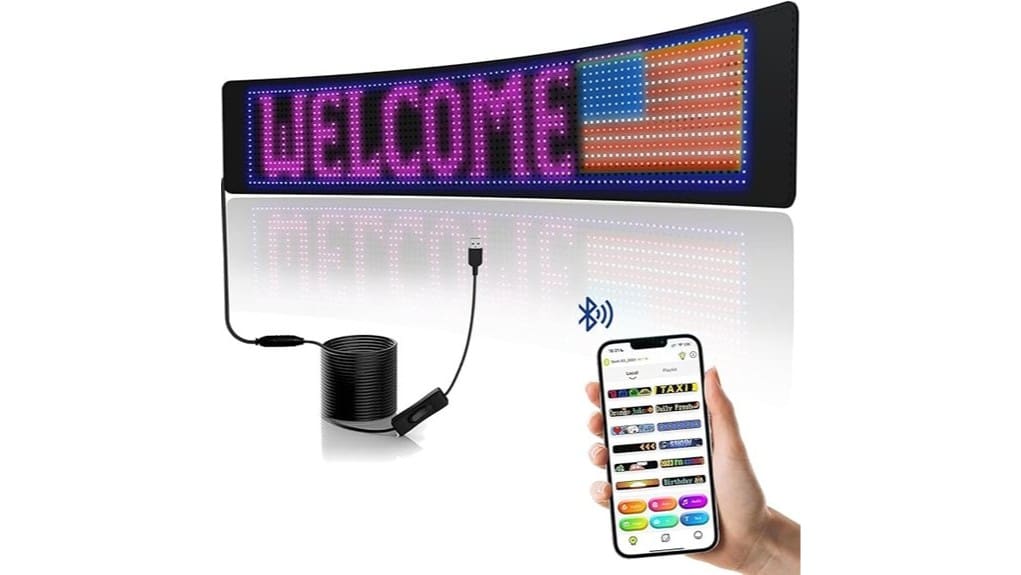
You’ll get a compact, USB‑powered RGB scrolling sign you control over Bluetooth via the POSWIS app, letting you program text, graphics and animations with presets, custom frames and multi‑unit sync. The 27″×5″ silicone LED strip is IP66 rated, daylight‑legible, energy‑efficient and simple to power from a car or power bank. Mounting uses silicone‑safe adhesives or low‑profile brackets; app previews and sync IDs simplify multi‑unit setups. Continue for setup tips, mounting notes and performance details.
Some Key Takeaways
- Brightness and legibility: high-RGB LEDs remain readable day and night, with adjustable output to balance visibility and power use.
- Ease of control: POSWIS Bluetooth app enables quick text, graphics, and animation editing without internet.
- Power and durability: USB 5V operation suits car supply or power banks; silicone and IP66 rating resist weather and dust.
- Mounting and fit: 27″ x 5″ flexible silicone strip fits many vehicle locations but may be too small for large-format messaging.
- Multi-unit and features: supports multi-unit sync, music sync, animation presets, and custom image import for coordinated displays.
What the Programmable LED Scrolling Sign for Car Is and Who Needs It
Think of the Programmable LED Scrolling Sign for Car as a compact, flexible RGB display you program via Bluetooth to show text, graphics, and animations on vehicles or fixed sites. You’ll deploy a 27″ x 5″ silicone LED strip (RXP-15-4) for targeted visibility, USB-powered and IP66-rated for outdoor resilience. You’ll use it for car marketing, fleet promotions, pop-up storefronts, or festival decoration where dynamic messages replace static signage. You’ll appreciate multi-unit sync, day/night visibility, and low power draw for prolonged operation. You’ll need basic mounting points and a power source; installer skills improve placement and message impact. This product is ideal for businesses that want outdoor sign letters to stand out in busy environments.
Hands-On Features: App Control, Display Modes, and Customization
Open the POSWIS app and you’ll control every display parameter of the 27″ x 5″ programmable LED sign via Bluetooth—no internet required. You connect quickly, access Bluetooth customization options, and edit text, graphics, and timing. Display modes include left, right, up, down, snowflake, and picture; you switch modes instantly and preview changes. Animation presets provide ready-made motion with adjustable speed and loop settings. You’ll create custom frames, import images, sync to music, and manage multiple units simultaneously. The interface is technical yet streamlined, prioritizing efficiency, precision, and rapid iteration for innovative on-vehicle signage. The site also offers guidance on designing eye-catching messages and best practices for programmable sign systems.
Real-World Performance: Brightness, Power, Durability, and Weather Resistance
After you’ve dialed in messages and animations in the app, the sign’s physical performance determines how those visuals read in real conditions. You’ll notice high RGB brightness delivers legible pixels day and night while adjustable output conserves energy. USB 5V power draws remain modest; you can run the panel from a car supply or power bank without complex adapters. Silicone construction and flexible PCB contribute to durability; the manufacturer rates expected longevity beyond ten years. IP66 waterproof testing confirms dust-tight and heavy-spray resistance, so exposure to weather won’t degrade function. Overall, the unit balances visibility, efficiency, and robust protection. These panels also pair well with backlit letter boards to brighten messages for drivers and pedestrians.
Setup, Mounting, and Multi‑Unit Use : Step‑by‑Step Tips
Get the sign mounted and linked quickly by planning placement, confirming power access, and pairing units with the app before final installation. You’ll test-fit the 27″x5″ module, verify USB 5V source reach, and choose adhesive selection rated for silicone and vibration. Use low-profile brackets or silicone tape where vibration and anti theft concerns exist. Route power and data with labeled runs; employ Velcro ties and trunk grommets for tidy cable management. Maintain airflow clearance around the LED strip to avoid heat soak. For multi‑unit setups, assign unique IDs in the app, verify sync, and trial animations before sealing. Consider using wind-resistant bases to keep outdoor signs stable in gusty conditions and reduce the chance of damage from high winds, especially when mounting near open windows or doors with sign base support.
Buy or Skip? Pros, Cons, Use Cases, and Final Recommendation
While the POSWIS Programmable LED Scrolling Sign (27″ x 5″) excels at delivering bright, customizable full‑color messages and animations with low power USB operation and IP66 durability, you should weigh its specific strengths—flexible silicone construction, Bluetooth app control, multi‑unit syncing, and day/night visibility—against limitations like dependency on a phone for advanced editing and the physical constraints of a 27″x5″ module for large‑format signage. You’ll buy if you need compact, portable, low‑power signage for cars, storefronts, or events; integrate with power banks or aftermarket batteries; and prioritize rapid iterations. Skip it if you require large signage, certified traffic compliance, or networked cloud management. The product fits well into retailers’ and event organizers’ offerings for customers seeking decorative and functional signs with bright LEDs and customizable messages, especially when paired with LED letter lights for coordinated displays.
Some Questions Answered
Is the Sign DOT or DOT-Compliant for Highway Use?
No, it isn’t DOT-compliant for highway use. You’ll need certified approval before road mounting; this unit’s flexible LED array and dot patterning aren’t tested to federal motor vehicle lighting standards. Perform formal visibility testing under regulated conditions to verify brightness, beam cutoff, mounting height and distraction limits. If you plan highway advertising, consult DOT guidelines, pursue laboratory photometric testing, and update hardware or mounting to meet legal requirements and safety certifications.
Can I Schedule Automatic On/Off Times Without the App?
No — you can’t schedule automatic on/off times without the app. The sign relies on Bluetooth app control to create timer schedules and manage advanced features; there’s no onboard scheduler or independent voice activation hardware. You can, however, pair the sign with external smart power (power bank with timer or smart plug supporting voice activation) to implement timed or voice-controlled power cycling, but that’s achieved outside the unit, not via built‑in functionality.
Does It Interfere With Car Electronics or Radio Signals?
No, it shouldn’t cause electrical interference or impact radio compatibility. You’ll connect the 5V USB-powered sign to a car power source or power bank, and its low-voltage, well-shielded circuitry minimizes emissions. Bluetooth control operates on standard LE channels and won’t disrupt FM/AM systems. For mission-critical installations, you can add ferrite beads or inline filters and verify vehicle grounding to further reduce any residual electromagnetic coupling.
Are Replacement Silicone Covers or Parts Sold Separately?
Yes — you can often buy replacement covers and spare panels separately from the manufacturer or authorized dealers. You’ll want to contact POSWIS support or check the parts catalog for RXP-15-4 to confirm compatibility, silicone color options, and pricing. Replacement components typically include the silicone outer cover and modular LED panels; make sure you request IP66-rated parts and confirm firmware/connector compatibility to maintain waterproofing, longevity, and multi-unit sync performance.
Can Multiple Users Edit the Same Sign Remotely via Bluetooth?
No — you can’t have multiple users edit the same sign remotely via Bluetooth simultaneously. Bluetooth supports multi user access only by sequential connections; the app manages one active session, so conflict resolution relies on last-write wins and local syncing when devices reconnect. You can pair several phones but they’ll sync changes serially. For true concurrent multi-user collaboration you’ll need a cloud-enabled or hub-based system that handles merges and real-time syncing.