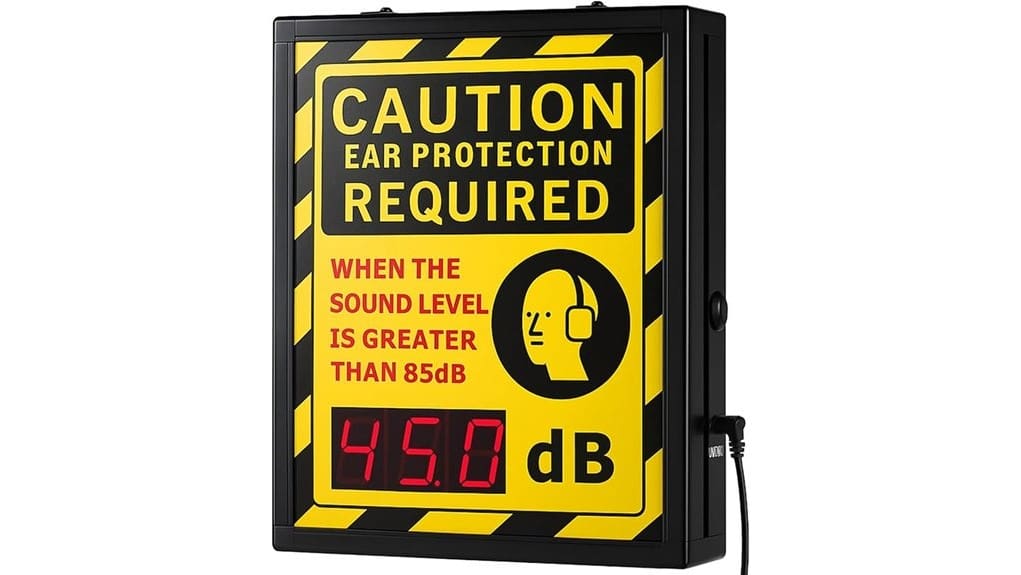
You’ll get a compact 12″ x 10″ LED decibel sign that gives near–real-time ambient noise readings (typically 30–130 dB) with about ±1.5 dB accuracy—good for routine workplace awareness though not a replacement for calibrated dosimeters. It’s bright, visible to roughly a 10 ft radius, mounts to walls, fences or doors with supplied hardware, and runs on 9 V DC with optional battery backup. Keep placement, weather protection and cable routing in mind; continue for setup, coverage and compliance tips.
Some Key Takeaways
- 12″ x 10″ aluminum digital sign displays real-time ambient noise with 1.5″ red LED digits, visible up to about a 10 ft radius.
- Measurement range listed as 30–130 dB (some docs say 0–130 dB) with ±1.5 dB accuracy suitable for awareness, not calibration.
- Near real-time updates and low latency make it effective for quick threshold triggers and hearing-protection reminders.
- Mounting uses a hidden bracket for wall, fence, or door at ear height; DC 9-V power plus optional battery backup recommended.
- Best for factories, workshops, and offices to promote safety culture; limited ~325 sq ft coverage and not a replacement for dosimeters.
What This 12″ X 10″ Sound Decibel Meter Sign Actually Does and Who Needs It
Think of this 12″ x 10″ Sound Decibel Meter sign as an always-on noise gauge that tells you, in real time, when sound levels reach ranges requiring hearing protection. You get a compact, wall-mountable digital display that quantifies ambient noise with ±1.5 dB precision and a visible three-digit LED readout. Compared to passive signs, it actively prompts behavioral change, supporting workplace ergonomics by reducing cognitive load around safety decisions. You’ll deploy it in factories, workshops, labs, or shared offices to codify a pro-safety hearing culture. It’s a technical, low-friction tool for innovators prioritizing measurable auditory risk mitigation. Protect Your Signs: weather shields help keep displays readable and durable in outdoor or harsh environments.
How the Display, Range, and Accuracy Perform in Real Workplaces
When you mount the 12″ x 10″ digital sign in a workspace, its 1.5″ high, three-digit red LED gives immediate, easy-to-read dB feedback across the unit’s 30–130 dB measurement window (documents sometimes list 0–130 dB), and the ±1.5 dB accuracy holds up for routine noise-awareness tasks. You’ll appreciate the minimal display latency—readings update in near real-time compared with handheld meters—so thresholds trigger quickly. Range covers typical shop floors; sensitivity favors human-audible risk zones. Expect low measurement drift over weeks with stable power and placement. For innovators, it balances transparency, ruggedness, and practical precision. Consider also basic sign cleaning practices to keep the display clear and legible in busy environments.
Installing and Powering the Sign: Step-by-Step for Walls, Fences, and Doors
Follow these steps to mount and power the 12″ x 10″ Sound Decibel Meter Digital Sign so it gives reliable, continuous readings: Position the hidden bracket against your wall, fence post, or door at ear height for representative sampling. Mark and secure with supplied hardware; for fences use stainless straps. Connect the DC 9-V cord, verify polarity, and test the LED readout. Plan cable routing to minimize exposure and trip hazards—use conduit for outdoor runs. If using battery backup, implement battery management: choose quality cells, monitor charge state, and schedule replacements. Finalize sealant for outdoor mounts and confirm continuous operation. Consider protective sign cases for outdoor installations to prolong device life and reduce maintenance needs by shielding from weather and impact, which is an important protective solution.
Durability, Size, and Visibility: Real-World Coverage and Mounting Tips
Although compact, the 12″ x 10″ Sound Decibel Meter Digital Sign delivers robust real-world coverage and durability that often outperforms bulkier displays; you’ll get a clear, 1.5″ high LED readout visible across its ≈10 ft (325 sq ft) radius while the aluminum body with protective coating resists typical workplace wear. You’ll mount it flush or angled using the hidden bracket for ideal sightlines; compare placements to avoid reflective surfaces. Weatherproof coatings extend outdoor life; select positions minimizing direct sun to exploit glare reduction and preserve LED contrast. At 2.94 lb, it’s lightweight yet rigid for stable, repeatable readings. The product is especially useful when paired with waterproof sign letters to create clear, weather-resistant outdoor messages.
Buying Decision Checklist: Pros, Cons, Compliance Fit, and Alternatives
Because you’ll weigh compliance, durability, and visibility against budget and alternatives, start by listing the concrete pros and cons and how the unit maps to your OSHA needs. You’ll get accurate ±1.5 dB readings, bright LEDs, aluminum build, simple wall or post mounting, and DC power with optional battery backup. Cons: limited 325 sq ft coverage, potential privacy concerns if signage is used with monitoring, and manual size variances. For compliance fit, it supports OSHA 29 CFR 1910.95 guidance but won’t replace calibrated dosimeters. Plan a maintenance schedule and user training. Consider calibrated dosimeters or networked displays as alternatives. Durable UV exposure protection helps signs remain legible and effective over time, making this a good choice for outdoor or brightly lit environments with UV-resistant lettering.
Some Questions Answered
Does the Sign Record or Log Historical Noise Data?
No — it doesn’t record or log historical noise data. You’ll get real-time dB readings on the LED, but there’s no onboard data logging or export for trend graphs. Compared to networked or software-enabled meters, this unit focuses on immediate awareness rather than archival analysis. If you need data logging and trend graphs for compliance or research, you’ll want a dedicated recorder or a smart meter with built-in storage and USB/network export.
Can the Display Brightness Adjust for Nighttime or Bright Sunlight?
Yes — you can adjust brightness: the unit offers adjustable brightness to suit nighttime or bright sunlight. You’ll compare settings manually for peak readability; an ambient sensor would be ideal, but this model relies on user-selectable levels rather than automatic adjustment. Technically, brightness control preserves LED longevity and contrast in varied lighting. If you want full ambient-sensor automation, consider upgraded models or external light sensors integrated into your monitoring system.
Is a Backup Battery Included for Power Outages?
No — a backup battery isn’t included; the unit ships with a DC 9-V power cord only. You’ll want to compare models if battery included? matters for uptime. Power longevity? depends on your external UPS or battery pack choice; the display and electronics are low-drain but rely on continuous DC supply. For innovative setups, integrate a compact 9V rechargeable backup or small UPS to guarantee uninterrupted monitoring and OSHA-aware alerts.
Does the Unit Require Periodic Calibration or Maintenance?
No — you won’t need routine calibration for basic use; the unit’s ±1.5 dB accuracy and real-time design minimize sensor drift compared with analog meters. Still, if you need laboratory-grade precision, implement a calibration schedule (annual or after impact events) and spot-check against a reference meter. Maintenance is limited: keep the sensor area clean, verify power stability, and replace if persistent offset or erratic readings indicate hardware degradation.
Are Multilingual or Customizable OSHA Headers Available?
Yes — you can get Multilingual headers and Customizable OSHA messages for this unit. You’ll compare standard “Ear Protection Required” text with tailored multilingual headers to meet diverse worksites. You’ll swap languages or change wording to match specific OSHA guidance, maintaining readability and visibility. Installation and firmware support remain minimal; you’ll appreciate the technical flexibility and quick field updates for compliance-driven, innovative noise-safety environments.