You’ll get a compact, weather‑resistant LED scrolling sign with about 96×96 pixels and ~1 cm pixel pitch that’s legible at typical storefront distances. It offers high daytime brightness with energy‑saving night modes, seven RGB tones, and an aluminum frame with sealed electronics for outdoor use. Control is via Wi‑Fi for remote updates or USB for offline playback, each with tradeoffs in security and workflow. Keep going and you’ll find setup, troubleshooting, and buying guidance.
Some Key Takeaways
- Confirm pixel density (≈1 cm pitch, 96×96) to ensure legible character size at your typical viewing distance.
- Choose Wi‑Fi for frequent remote updates and scheduling, or USB for simple offline, single‑location reliability.
- Verify peak brightness and energy‑saving night modes for daytime visibility and neon-like nighttime legibility.
- Inspect build quality: aluminum alloy frame, weather seals, and wind‑resistant mounting for outdoor durability.
- Check control latency, firmware update process, and troubleshooting support before purchase for operational reliability.
Real-World Specs and What They Mean for Your Use Case
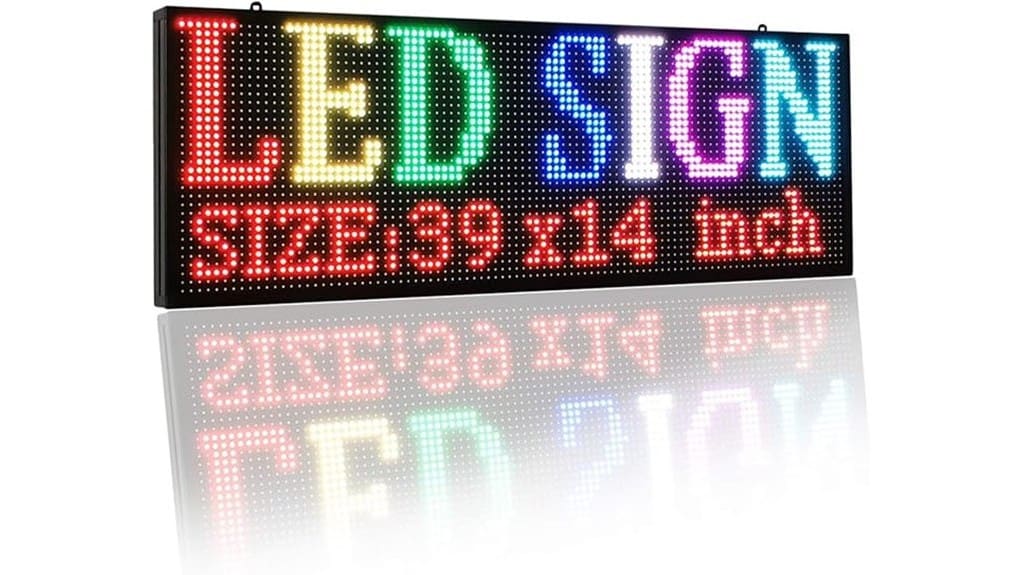
When you evaluate the sign’s real-world specs, focus on dimensions, resolution, brightness, and control options to match your installation and messaging needs. You’ll see compact dimensions (≈100.08 x 19.05 x 5 cm) and a 96×96 pixel resolution yielding predictable character size. Pixel density (1 cm pitch) determines viewing distance and legibility for storefronts or counters. Assess brightness for daytime visibility and energy-saving modes for night. Consider control latency and offline playback limits. Factor weight and mounting clearances. Estimate continuous power draw from SMD efficiency to plan supply and thermal management. Match specs to placement and messaging cadence. Also consider selecting a wind-resistant base when installing outdoors to keep the sign standing.
Two Ways to Control Content: WiFi vs USB – Which to Pick?
How do you pick between WiFi and USB control for this outdoor LED sign? You’ll choose based on workflow, connectivity, and risk tolerance. Wi‑Fi offers remote updates from mobile or computer, real‑time scheduling, and integration potential, but assess Wi‑Fi security, firmware updates, and network segmentation to reduce attack surface. USB suits offline, single‑location use: edit on a computer, copy to a flash drive, and the sign plays stored files—benefit is strong USB compatibility and no network exposure. If you need frequent dynamic content, pick Wi‑Fi with hardened settings; if you want simple, resilient playback, rely on USB. Durable UV-resistant letter sets help ensure long-lasting outdoor visibility and reduced maintenance needs for mixed signage deployments with digital and physical elements like UV-resistant letters.
Brightness, Visibility, Durability: Day/Night and Weather Performance
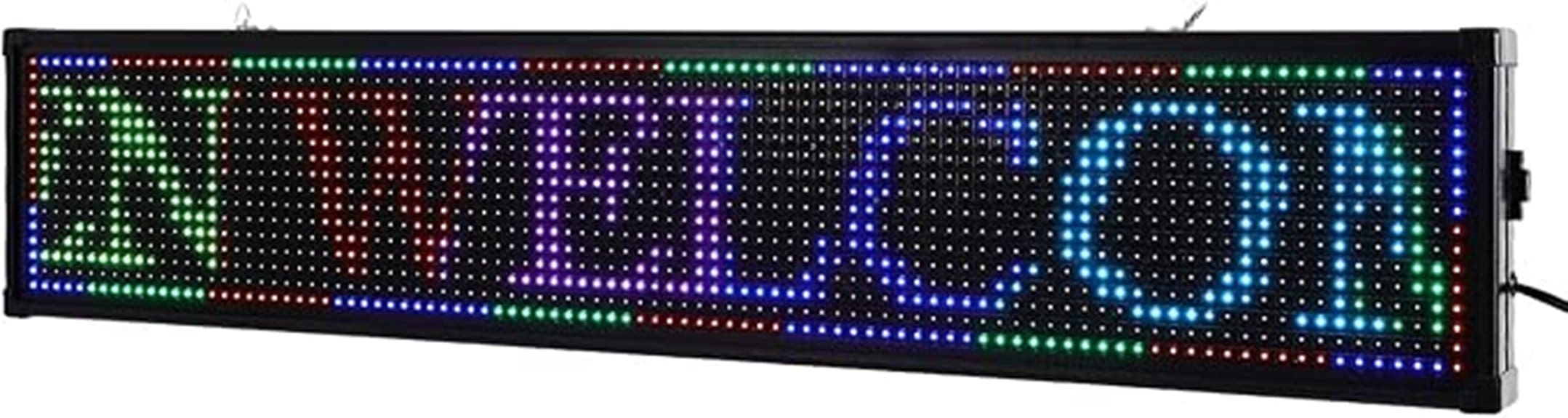
After deciding between Wi‑Fi and USB control, you’ll need to evaluate how the sign performs visually and mechanically across lighting and weather conditions. You’ll assess daytime energy‑saving brightness versus neon‑like nighttime output, verifying legibility at typical viewing distances and performing contrast testing to guarantee color separation across seven RGB tones. The aluminum alloy frame and weather‑resistant composite panel resist corrosion and deformation; seals protect electronics from moisture. Factor in high‑frequency SMD LEDs for continuous operation and a planned maintenance schedule to inspect seals, connectors, and LEDs. These checks extend lifetime and maintain consistent visibility in harsh outdoor environments. Consider adding a weather shield to protect your sign and preserve message clarity in severe conditions.
Setup, Editing, and Common Troubleshooting Tips
Start by unpacking the sign and laying out the included parts: LED unit, power adapter, mounting hardware, USB cable, and manual. Mount per instructions, connect power, and choose WiFi or USB mode. Edit messages via app or PC, upload via data line or save to USB for offline playback. Calibrate color calibration profiles in settings to guarantee accurate seven-color output. Apply remote firmware updates to fix bugs and add features. Troubleshoot by checking power continuity, cable integrity, and WiFi signal; reset to factory defaults if needed. Log errors, contact support with firmware version and reproduction steps for efficient resolution. Our shop offers compatible mounting and accessory options to help customize and maintain your sign outdoor sign letters.
Who Should Buy This Sign (and Alternatives to Consider)
Having completed setup and basic troubleshooting, you can now evaluate whether this LED scrolling sign matches your needs. You should buy it if you run a small business needing durable, weather-resistant, high-brightness messaging with WiFi/USB control and low energy draw for continuous operation. Event planners will value compact size, seven-color options, and reliable outdoor visibility for schedules or promotions. If you need higher resolution, larger displays, or full-motion video, consider modular LED panels or larger pitch boards. For ultra-low-cost or indoor-only needs, simple LED marquee signs or printed banners may be more appropriate. Durable waterproof sign letters make these displays especially suitable for outdoor use.
Some Questions Answered
Does the Sign Support Multiple Languages or Custom Fonts?
Yes — you can display multiple languages and design custom fonts. You’ll get multilingual support via the editing software (computer or mobile) that uploads UTF-compatible text, and you can import or create custom glyphs for unique characters or logos. The USB playback preserves those assets for offline use. You’ll need to confirm font compatibility and encoding in the app, and create bitmapped glyphs if the built-in font set lacks specific characters.
Can I Mount It Vertically as Well as Horizontally?
Yes — you can mount it vertically (Portrait orientation). You’ll align the aluminum frame and secure mounting points per the manual, ensuring weather seals and cable routing remain intact. Software supports rotated content or you can edit messages for portrait aspect ratios. Verify mounting hardware load ratings and use appropriate anchors for outdoor conditions. For innovation, consider modular brackets or quick-release mounts to switch between horizontal and vertical configurations efficiently.
Is There a Timer or Scheduling Feature Built Into the Unit?
Yes — it includes a built in scheduler you can configure. You’ll use remote programming via WiFi or a connected device to set timed playlists, brightness profiles (day/night), and on/off cycles. The scheduler supports recurring events and USB-stored programs for offline run-mode. You’ll find options for precise start/stop times, repeat patterns, and immediate overrides through the app or computer interface for automated, low-maintenance signage management.
What Is the Estimated LED Lifespan Under Continuous Use?
You can expect an estimated lifespan of roughly 50,000 to 100,000 hours under continuous operation. That range reflects SMD LED efficiency, thermal management, and typical outdoor usage. With proper ventilation and daytime dimming the module sustains luminance longer; without thermal control you’ll see accelerated lumen depreciation. For innovation-focused deployments, integrate scheduled brightness reductions and routine maintenance to maximize lifetime and maintain consistent color/brightness performance.
Are Replacement Parts (Led Modules, Power Supply) Available?
Yes — you can obtain replacement modules and power supplies, though availability varies. You’ll typically source original parts from the manufacturer or authorized dealers; third party supplies are also compatible if they match specs (voltage, current, connector type, module pitch). You should verify electrical ratings and form factor, and test replacements for heat dissipation and waterproofing. Keep documentation and vendor warranty info; use certified components to maintain reliability and service life.